Search the Archive

Person among large standing stones in a field
A person stands among several large, weathered standing stones in a grassy field. The background shows more fields, a fence, and distant hills under a light sky.
The Zanna Smith Archive · August 20, 2026

Woman in a field of red and yellow tulips
A woman stands in a field with rows of yellow and red tulips. She is wearing a floral shirt and blue pants, with a camera around her neck.
The Zanna Smith Archive · August 20, 2026

Woman, megalithic structure, and animal in field
A woman in light-colored clothing stands next to a large megalithic stone structure in a grassy field. A light-colored animal is partially visible behind the structure, and a body of water is in the background.
The Zanna Smith Archive · August 20, 2026
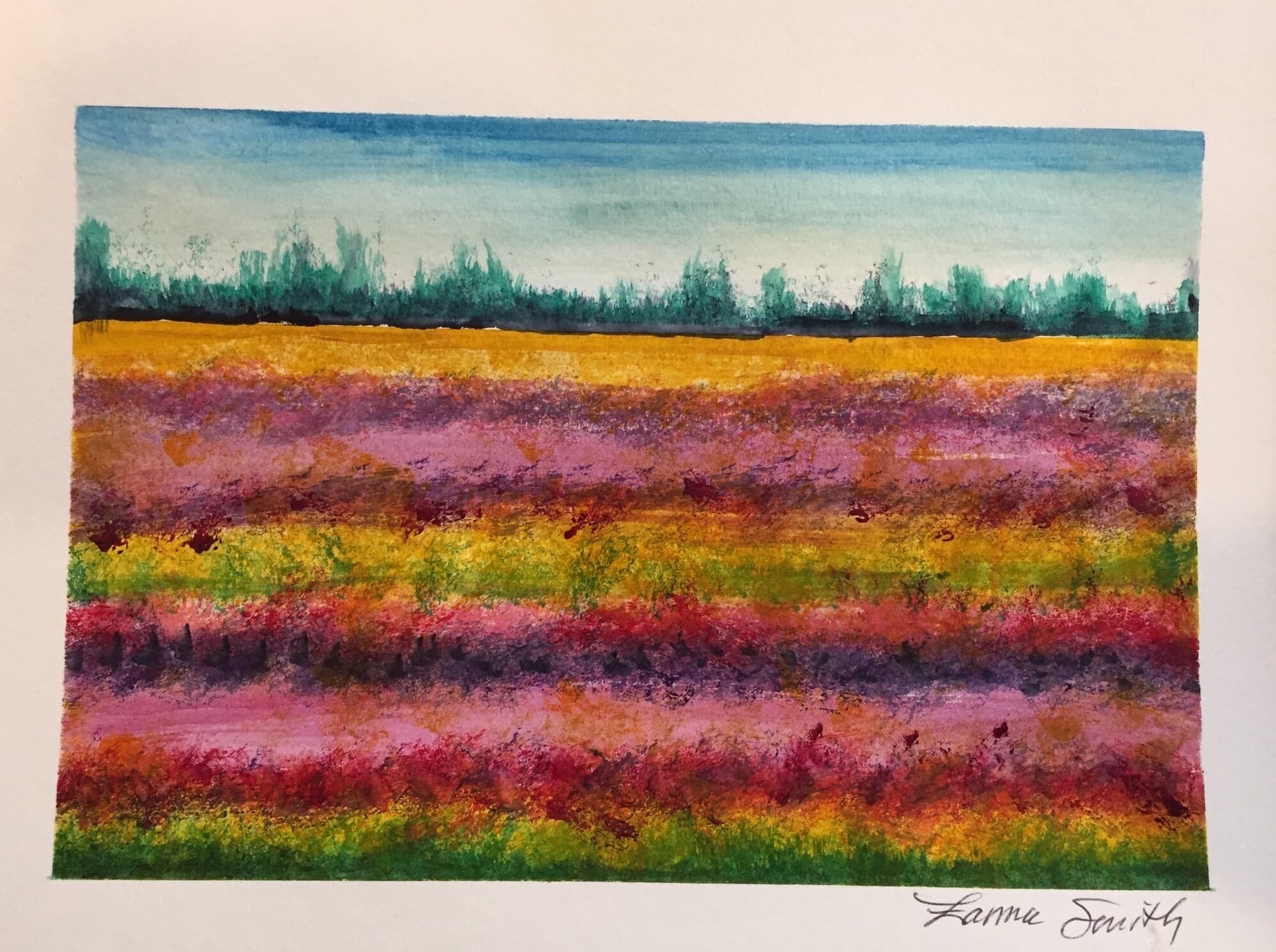
Banded Field Under a Treeline
This watercolor painting depicts a broad field rendered as horizontal bands of magenta, gold, plum, and green, running back to a dark treeline beneath a pale blue-green sky. The color is stippled and layered so the bands read as blooming crops rather than flat stripes.
Zanna Smith · August 29, 2026
Process
Ch. 4›Results
After the participants had checked their individual transcripts and returned them, I digitally transferred them into case nodes in NVivo10. As I listened again to the recordings, and reread the transcripts, I annotated them with my field note observations, and coded them into a hierarchical set of nodes based on the interview questions.
Zanna Smith · August 17, 2026
Choice of Methodology
Ch. 3›Research Methodology
The study used a paradigm based on the interpretative phenomenology of van Manen (1990) and descriptive phenomenology of Moustakas (1994). The phases of the study were interwoven, rather than completed in discrete steps. Keeping a field journal was an important part of maintaining cohesion and coherence.
Zanna Smith · August 17, 2026

Woman on pole, baseball game, and feet
This image shows three distinct black and white photographs mounted on a textured, light-colored page. The top photograph, partially visible, shows a row of feet in shoes and a dark background. The bottom left photograph depicts a woman in a light-colored blouse and dark skirt climbing a pole, with a building and trees in the background. The bottom right photograph shows a person swinging a bat on a baseball field, with spectators and a large building in the background.
The Zanna Smith Archive · August 20, 2026

Red Car Parked by Roadside
A red car is parked on the side of a road with a person standing near the rear of the vehicle. The background shows a field and trees with autumn foliage.
The Zanna Smith Archive · August 20, 2026
Recording of Data
Ch. 4›Results
In every case the participants agreed to have their interviews audio recorded. In addition I took notes in my field journal. The first interview, conducted by phone, was recorded by putting the phone on speaker phone and recording by digital recorder.
Zanna Smith · August 17, 2026
Data Collection
Ch. 4›Results
Data was collected in several ways. The primary source was from semi-structured interviews, using the questions in Appendix E as a guideline. Seven nurses from various departments at several hospitals participated, as shown above in Table 4,. Additional data was collected through my observations and notes in a field journal, and through the participants‘ memberchecks of the transcribed interviews.
Zanna Smith · August 17, 2026
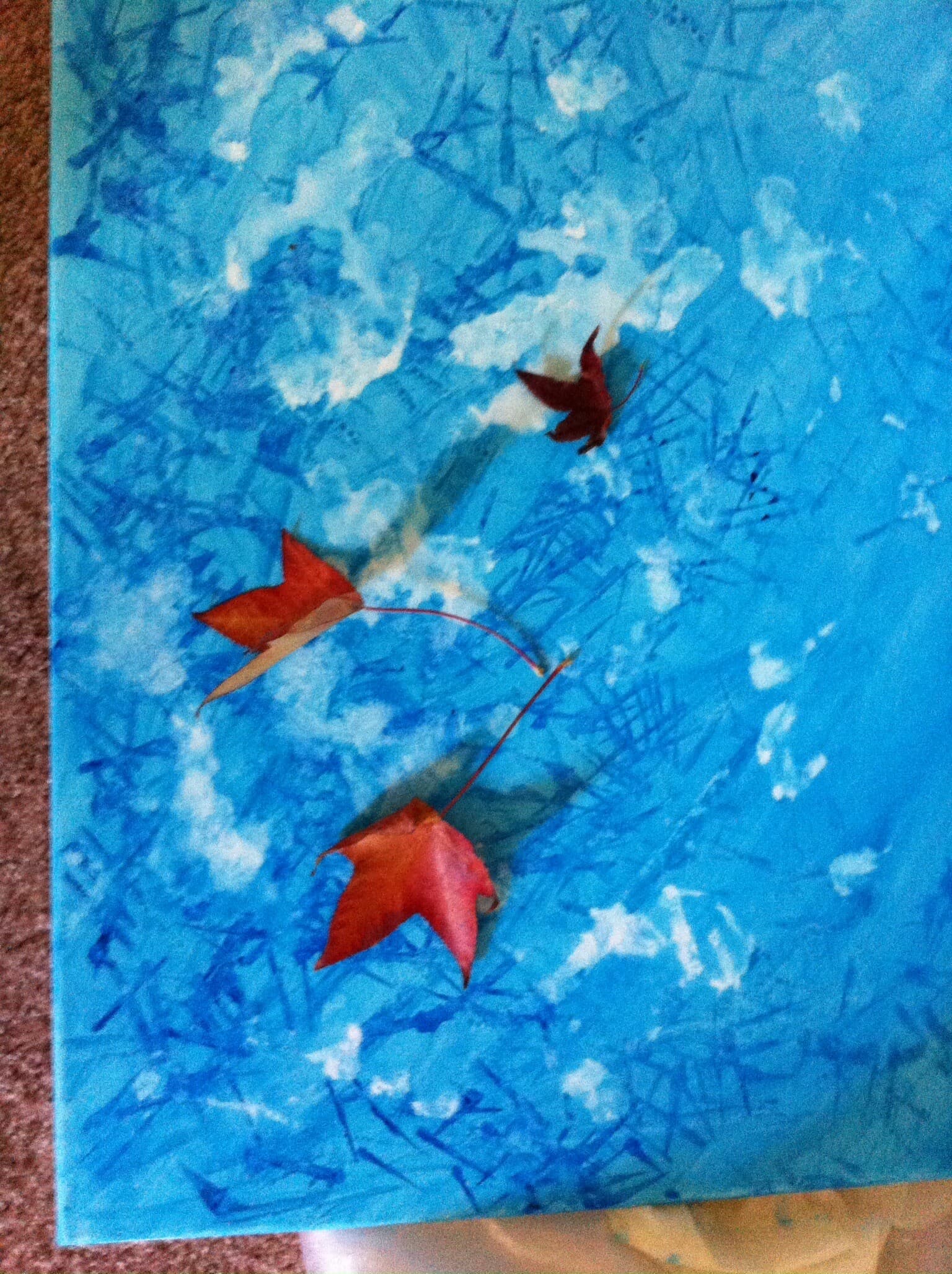
Red Maple Leaves on Blue
This mixed media work sets three red maple leaves against a textured blue and white painted panel scratched with crosshatched marks. The leaves cast soft shadows that read as movement across the field of blue.
Zanna Smith · August 29, 2026
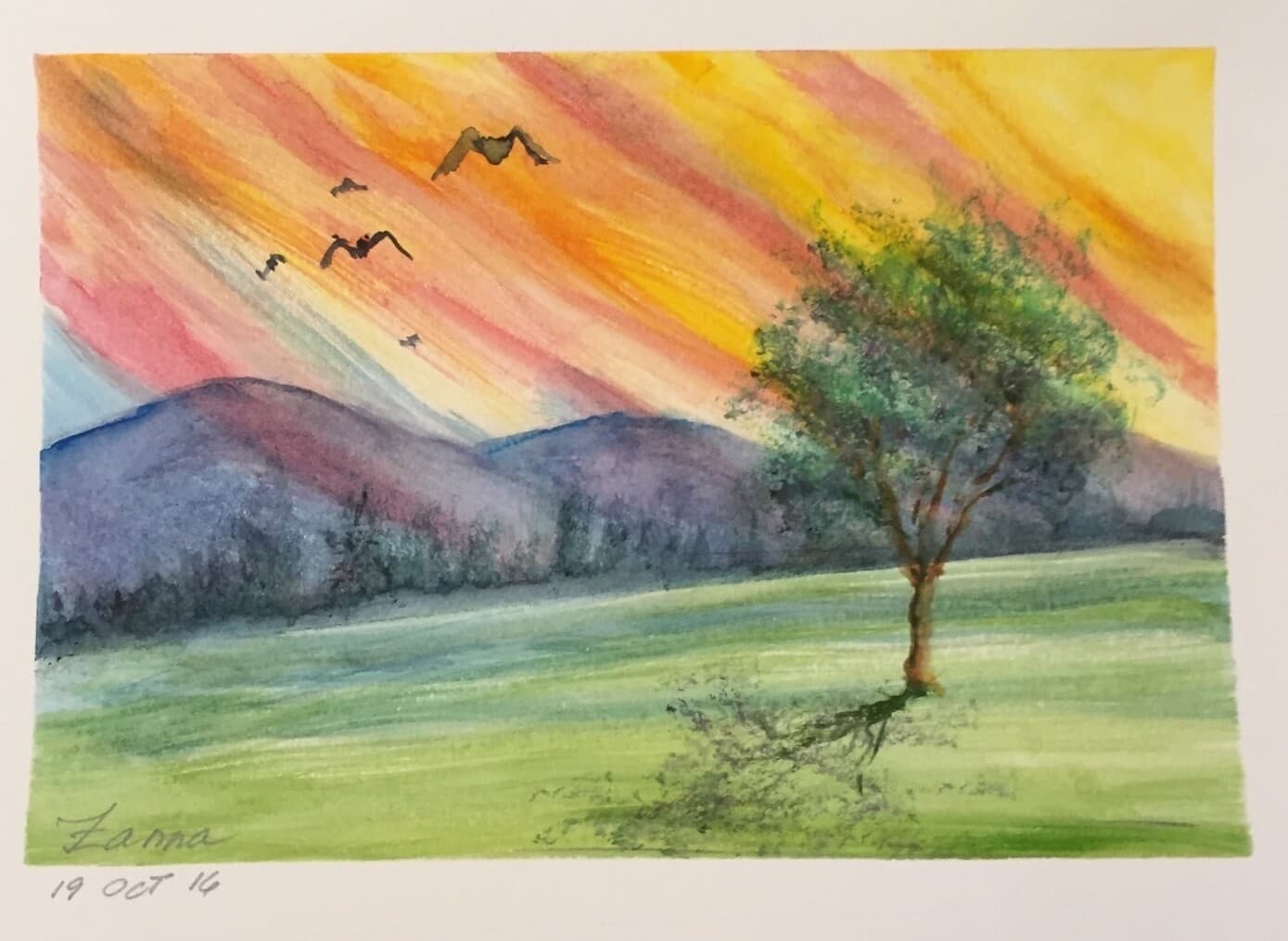
Lone Tree at Sunset with Birds
This watercolor painting depicts a single leafy tree standing in a green field beneath streaked bands of orange, gold, and rose sky, with layered blue-violet hills behind and a small flock of birds crossing the upper left. The wash work is controlled and graded, letting the sky carry the drama while the foreground stays quiet.
Zanna Smith · August 29, 2026

Magenta Vortex
This abstract painting, in acrylic or heavy-bodied watercolor, swirls magenta, violet, and crimson around a turquoise and cobalt core, with black calligraphic strokes arcing through the composition. Spattered flecks of yellow and red concentrate at the center, suggesting a burst held inside a rotating field.
Zanna Smith · August 29, 2026
Development of CF (1.2): Daily exposure ―to loss – loss of expectations, loss of
Ch. 4›Results
life and limb, whatever‖ contributes to the development of compassion fatigue ([A6, December 7, 2012](/dissertation/references)). Compassion fatigue comes from ―having to face situations in which compassion is required, as a professional, every day, hour after hour, minute after minute, every single day. And after so much time, you‘re going to become fatigued‖ (P5, 23 November 2012).
Zanna Smith · August 17, 2026
Moustakas
Ch. 2›Literature Review
The transcendental phenomenological approach developed by Moustakas was based on a dynamic model which evolved as the essence of the phenomenon was uncovered ([Davis, 1998](/dissertation/references)). Moustakas‘s term ―transcendental‖ referred to a methodology which included the process of Epoché, acknowledging the presence of the researcher in the study ([Giorgi, 2006; Moustakas,...
Zanna Smith · August 17, 2026
Experience of Resiliency to CF
Ch. 4›Results
Empathy in the workplace (1.1). In Figley‘s 2002 model, empathy was the starting point of compassion fatigue. The distinction between empathy and compassion is part of understanding the participant nurses‘ experience of resiliency to CF.
Zanna Smith · August 17, 2026
Evidence of Quality and Trustworthiness
Ch. 4›Results
Following the recommendations of Creswell (2007), the standards of trustworthiness and quality of the study are based on: (a) the depth of my understanding of the principles of phenomenology philosophically and in research; (b) the clarity of the phenomenon of CF resiliency, and the presentation of this in an articulate and concise manner; (c) the use of trustworthy process based on recognized...
Zanna Smith · August 17, 2026
Summary of Processes and Security Precautions
Ch. 3›Research Methodology
The steps to be taken in the proposed study, after approval by the appropriate IRBs are: 1. Recruitment: Before attending a monthly meeting of the Oncology Local Practice Council, to which I have been invited, I will talk with the coordinator for this meeting. At the monthly meeting I will make a brief presentation of the project, and request referrals to potential participants.
Zanna Smith · August 17, 2026
Recording and Transcription
Ch. 3›Research Methodology
As noted above, the interviews were audio-recorded, with the participants‘ permission, as well as hand-noted. The audio-recordings and transcriptions were stored on a password-protected peripheral hard drive, and kept in a locked box, separate from the computer. Before transcription, I removed any identifying information.
Zanna Smith · August 17, 2026
Areas for Future Investigation
Ch. 5›Discussion, Conclusions, and Recommendations
Too little is known about the positive outcomes from dealing with trauma, such as posttraumatic growth and vicarious resilience. Most of the studies about CF have been correlative, quantitative, based on limited populations, and focused on risk factors, rather than resiliency strengths.
Zanna Smith · August 17, 2026
Verification of Authenticity and Trustworthiness
Ch. 3›Research Methodology
Credibility, or internal validity, can be damaged in a study if sampling bias or omission of point of view occurs. In quantitative research, reliability, validity, and replicability are the parameters of authenticity and trustworthiness, but using those terms in qualitative research makes little sense due to the research paradigms used ([Williams & Morrow, 2009](/dissertation/references)).
Zanna Smith · August 17, 2026
Use of NVivo 10 Software
Ch. 3›Research Methodology
Use of qualitative data analysis (QDA) software aided me in a number of ways, such as providing a single location for storage of data, and use of consistent coding schemes. I have considered the possible disadvantages and limitations, beyond the time needed to become proficient in using the program.
Zanna Smith · August 17, 2026
Data Analysis Techniques
Ch. 3›Research Methodology
The analytic process was similar to ethnographic research in that the coding and study of interrelationships began when the first interview has been conducted, and was refined as the data was collected ([LeCompte & Schensul, 1999b](/dissertation/references)).
Zanna Smith · August 17, 2026
Role of the Researcher
Ch. 3›Research Methodology
In phenomenology the researcher takes a subjective role within the study ([Creswell, 2007; Moustakas, 1994; van Manen, 1990](/dissertation/references)). I bracketed my preconceptions, experiences, and theories, using epoché, following Husserl (1931) and Moustakas (1994). Doing this enhanced my ability to be fully present with each person.
Zanna Smith · August 17, 2026
Areas for Future Investigation
Ch. 2›Literature Review
Too little is known about the positive outcomes from dealing with trauma, such as posttraumatic growth and vicarious resilience. Most of the studies about CF have been correlative, quantitative, based on limited populations, and focused on risk factors, rather than resiliency strengths.
Zanna Smith · August 17, 2026
Biopsychological Factors of Empathy
Ch. 2›Literature Review
There is no single, universally accepted definition of human empathy, as noted above. It may take stepping into a higher plane of consideration of all recent empathy studies, with integration of significant findings and thought.
Zanna Smith · August 17, 2026
Nature of the Study
Ch. 1›Overview of the Study
The study advances knowledge about the experience nurses and other healthcare professionals (HCPs) have with CF, and resiliency to it. Seven nurses from various areas of hospital medical practice, each with more than 15 years of experience in nursing, were interviewed.
Zanna Smith · August 17, 2026